Your Brain on Break Point: Why Good Players Choke
You've been here before. Up 30-0 on their serve, sensing the break. Then your brain starts thinking instead of playing, and suddenly you're watching easy shots sail long. Here's what's actually happening in your head under pressure.
You've been here before
You're up 30-0 on their serve. You can feel it — the break is coming. Your opponent looks tight, double-faulted twice this game already. This is your moment.
Then something shifts. Instead of seeing the ball and reacting, you start thinking. Don't blow this. Just get it back. Make them beat you. Your racquet feels heavy. That backhand you've hit a thousand times suddenly feels foreign. The next thing you know, you're watching an easy approach shot sail three feet long.
30-15. 30-30. Deuce. Game to them.
You just choked. But you have no idea why your brain betrayed you when it mattered most.
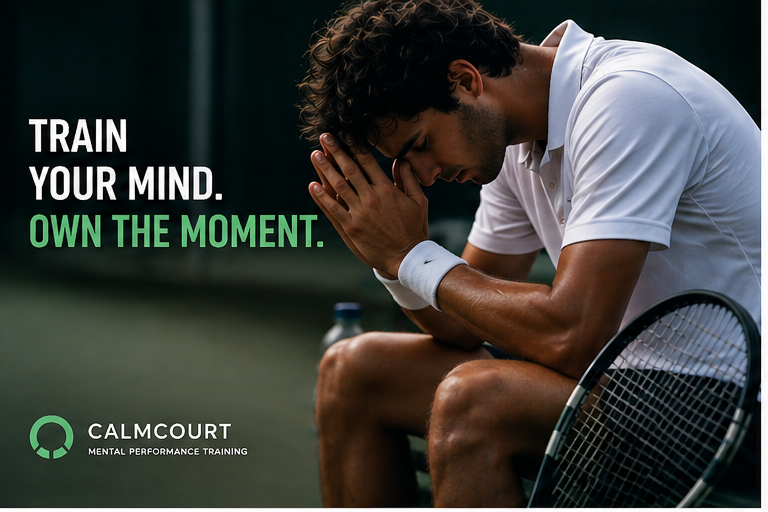
Your brain has two operating systems
What happened on that break point wasn't a stroke problem. It was your brain switching operating systems without your permission.
Under normal conditions, you play from what neuroscientists call the automatic system. This is where your muscle memory lives. You see ball, you hit ball. No conscious thought required. It's fast, fluid, and feels effortless.
But when the stakes rise, your brain activates the controlled system. This is your conscious, thinking mind. It's slow, analytical, and wants to micromanage every detail. In break point moments, it hijacks your swing.
Pressure doesn't create new problems. It reveals which system is running your tennis.
The controlled system isn't evil — it's trying to help by taking conscious control when it senses danger. But tennis shots happen too fast for conscious thought. When you think your way through a forehand, you're using the wrong tool for the job.
The solution isn't to eliminate pressure. It's to train your automatic system to stay online when your controlled system wants to take over.
The between-point reset protocol
Here's a simple protocol you can use today to keep your automatic system engaged, even on break points.
After every point — win or lose — do this:
Turn your back to the court and take three deep breaths. Not meditation breaths, just normal deep breaths. Count them: one, two, three.
Then pick one simple technical cue for the next point. Not three cues, not a strategy, just one thing your body already knows how to do: "watch the ball," "turn my shoulders," or "finish high."
Walk to your position with that cue in mind. Nothing else.
The reset isn't about relaxation. It's about giving your automatic system permission to do what it already knows.
This works because the controlled system needs something to do. If you don't give it a job, it will invent one — usually obsessing over the score or what just happened. The single cue keeps it busy while your automatic system runs the point.
The breathing serves a different function. It activates your parasympathetic nervous system, which tells your brain the immediate threat has passed. This makes it less likely to switch into controlled mode on the next point.
Why repetition under stress builds pressure immunity
Your automatic system gets stronger every time it successfully operates under stress. This is why some players seem immune to pressure — they've trained their automatic system to stay online regardless of the situation.
When you practice shots in low-pressure situations, you're building muscle memory. But muscle memory alone isn't enough for pressure moments. You need what researchers call pressure-tested automaticity — skills that remain automatic even when your controlled system is screaming for attention.
This happens through a process called stress inoculation. Each time you successfully use your reset protocol in a pressure moment and trust your automatic system, you build confidence in that system. Your brain learns: "I can handle this without thinking my way through it."
Confidence isn't a feeling. It's proof that your automatic system can handle what's coming.
The magic happens when the protocol becomes automatic itself. You no longer have to remember to turn and breathe — your body just does it. At that point, you have a reliable bridge between pressure and performance.
Training your brain for pressure moments
This is where daily mental training becomes crucial. You can't just practice the reset protocol during matches and expect it to work. Your brain needs repetition under guided stress to build the neural pathways that keep your automatic system online.
CalmCourt helps players train this exact process through daily pressure scenarios. Instead of hoping you remember to use your reset when the break point comes, you practice it until it's as automatic as your forehand.
The app simulates pressure moments and guides you through the mental protocols that keep your automatic system engaged. Each session builds the stress immunity you need for real matches. It's not meditation or relaxation — it's pressure training for your brain.
Think of it like a gym for your mental game. You wouldn't expect your backhand to improve without repetition. Your brain's pressure response works the same way.
Join the players training their minds daily
The difference between choking and clutch isn't talent. It's training. Players who perform under pressure have taught their brains to stay in automatic mode when it matters most.
CalmCourt's early access program gives you the same mental training protocols used by touring professionals. Join the players who are already building pressure immunity one rep at a time.
Join early access and start training your brain for the moments that matter.
Train the mental side — one tip a day for 7 days
Short, tactical, tennis-specific. Built for the pressure moments you already lose points on.
One email a day for 7 days. Unsubscribe any time.
Frequently Asked Questions
Related Articles
Ready to train your mental game?
Calm Court gives you tactical mental tools — before, during, and after every match.
Download Calm Court